



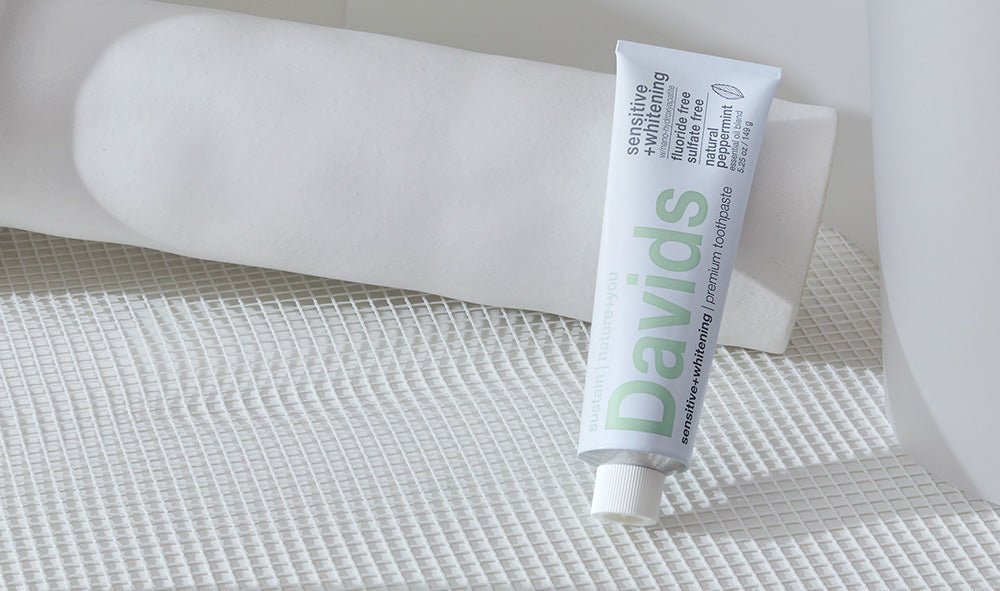
Hydroxyapatite is generating a wave of excitement in the world of oral care, and rightfully so. But naturally, this wave of excitement comes with a lot of questions. Is it safe? Does it really work? How do I know which product is the best?
We completely understand and appreciate the curiosity. After all, nano-hydroxyapatite is the new kid on the block! To address some of your questions and ease some of your doubts, we're answering these questions head-on...and citing scientific studies along the way.
We could talk for days about how much we love this ingredient (and why), but we know straightforward answers that reference peer-reviewed scientific sources may be a bit more useful for you.
Don't worry, we're not offended. We're ready to dive in.
is hydroxyapatite safe?
The short answer to this question is yes. Hydroxyapatite itself is a non-toxic, biocompatible mineral that already exists naturally in your body. In fact, it makes up roughly 97% of your tooth's outer surface.
Hydroxyapatite toothpaste is safe when formulated intentionally and carefully. (And we can guarantee that Davids has been formulated with the utmost intention and care.) Now, when we say that the safety of hydroxyapatite toothpaste depends on its formulation, we mean…
The size of hydroxyapatite particles matters. Nano-hydroxyapatite particles are between 20-80 nanometers, and research shows that this tiny particle size is most effective in strengthening, protecting, and supporting your teeth. Think about it this way, the erosion/damage on your teeth (enamel damage, cavities, and the tubules that can become exposed as a result) occur on a nano-level, so you'll want nano-sized particles to help!
Diligent user/lab testing matters. How can you prove the safety+efficacy of toothpaste without lab testing? We're thrilled to say that we submitted samples of the top competing sensitive toothpastes to one of the largest and most trusted third-party laboratories that specialize in oral care product testing, and Davids significantly outperformed the competing products by most effectively plugging the tubules and blocking the passageways to the nerves to support sensitive teeth.
The other ingredients in the toothpaste matter. Hydroxyapatite is an amazing ingredient, but what if it's coupled with other not-so-great ingredients? At Davids, we use the highest quality ingredients across the board. Trust us, our formula of premium ingredients took over 4 years to perfect.
does the % of hydroxyapatite in hydroxyapatite toothpaste matter?
The short answer is: it's not that simple.
You'll find that some functional dentists recommend looking for hydroxyapatite toothpaste with "at least X% of hydroxyapatite" in the formula.
But the truth is, toothpaste with 10% hydroxyapatite (no we don't use 10%) can be more effective than toothpaste with 50% hydroxyapatite. The efficacy of the toothpaste depends on so much more than the % of the hero ingredient, such as the type and grade of material being used.
what percentage of Davids Sensitive+Whitening Nano-Hydroxyapatite Toothpaste is actually nano-hydroxyapatite?
We do not disclose % as this is proprietary information to our formulation, and does not provide any meaningful info on how the toothpaste actually performs. The 3rd party lab testing we did shows that we outperformed all the leading competitive brands of hydroxyapatite toothpaste submitted and most effectively plugged the tubules to support sensitive teeth. Please visit our website to see photos as part of our lab results that show the effectiveness of our formulation.
what's the difference between hydroxyapatite, nano-hydroxyapatite (n-HA), and micro-hydroxyapatite?
Hydroxyapatite is the name of the mineral itself, and for those interested, its chemical formula is Ca10(PO4)6(OH)2. Hydroxyapatite makes up roughly 97% of your enamel, and hydroxyapatite-like compounds make up roughly 65% of your bones!
Nano-hydroxyapatite (n-HA) is hydroxyapatite with tiny particle sizes between 20-80 nanometers. Scientific studies confirm that these nanoparticles are more effective than microparticles in binding to the proteins in your saliva and, in turn, the surface of your enamel. This allows it to strengthen the surface of your tooth + plug the tubules that lead to your tooth's nerve and support sensitive teeth. This is why most toothpastes with hydroxyapatite (including Davids) utilize nano-sized particles.
Micro-hydroxyapatite particles are at least 1,000 larger than nano-hydroxyapatite particles. They are less effective in treating dental erosion/damage because they do not interact/bind as well with the cells and surfaces in your oral microbiome.
While nano-hydroxyapatite is more effective than micro, Dr. B of Ask the Dentist confirms that there are no safety concerns regarding the absorption of particles based on size. In other words, both micro and nanoparticles can (and will) be absorbed by your cells, which is not an issue because hydroxyapatite is both non-toxic and biocompatible.
For more information, we recommend listening to his podcast episode, "Does Size Matter?"
how long does it take for hydroxyapatite toothpaste to support sensitive teeth?
This study reveals that nano-hydroxyapatite toothpaste is an effective option for sensitive teeth and can provide noticeable support after 2-4 weeks of regular use.
Our third-party lab testing revealed that our unique formula was effective in bonding to your enamel and plugging the passageways to your tooth's nerve to support sensitive teeth after just five days of twice-daily brushing.
can hydroxyapatite help to reverse cavities?
Yes, because it's so effective in strengthening your enamel, hydroxyapatite can help reverse cavities and prevent new ones from forming!
Check out this article with studies compiled by Mark Burhenne, DDS (of Ask the Dentist) & Jacqueline Carcaramo, RDH. Many of the studies discuss how effective hydroxyapatite is at strengthening your teeth and reducing dental caries.
how do I know which one is the best hydroxyapatite toothpaste?
We may be biased, but our third-party lab testing results are not.
We submitted samples of the top competing sensitive toothpastes to one of the largest and most trusted third-party laboratories that specialize in oral care product testing to see how well Davids Sensitive+Whitening Nano-Hydroxyapatite toothpaste would perform against the competition.
All numerical and photo evidence from the lab results showed that Davids significantly outperformed the competing products by most effectively plugging the tubules and blocking the passageways to the nerves to support sensitive teeth. In other words, science reveals that Davids is the best toothpaste with hydroxyapatite!
Competing products include Apagard Premio, Boka, Colgate Sensitive, Risewell, Sensodyne Pronamel, and Toms Sensitive.

how can I use hydroxyapatite best (to maximize benefits) in my oral care routine?
Here are a few tips:
- Brush (at least) twice daily with Davids Sensitive+Whitening Nano-Hydroxyapatite Toothpaste, as it outperforms its competitors.
- Start right away, even if you don't have sensitivity! Like most ingredients, hydroxyapatite works best as a preventative measure. In fact, research reveals that hydroxyapatite can effectively reduce and prevent tooth decay, especially in children.
- Enhance the health of your oral microbiome by eating a nutrient-dense diet that aids strong, healthy teeth.
- Elevate your holistic oral care routine with daily flossing and tongue scraping.
- Stay consistent. One of the best ways to do this is to take note of how your teeth feel once you start using nano-hydroxyapatite toothpaste.
try it out yourself!
You can continue to read our rave reviews+results as much as you want, but the proof is in the paste! Try out our revolutionary hydroxyapatite toothpaste for yourself.


