



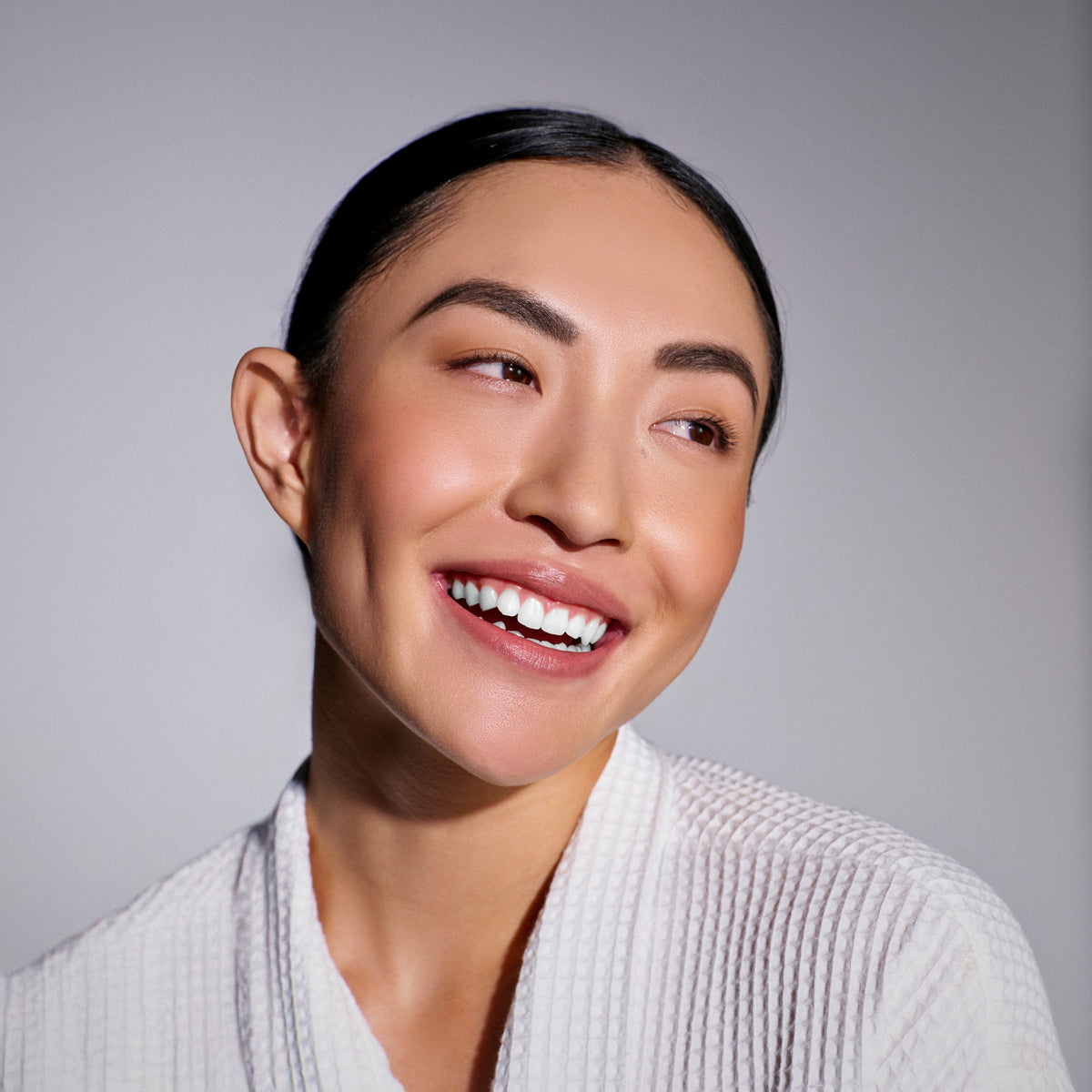
Your smile is one of the first things people notice about you, often before you’ve said a single word. It can signal confidence, warmth, and approachability. But more importantly, your smile has an important relationship with how you feel.
That’s why this intersection between your mental health and your smile truly matters. It’s not about chasing a “perfect” smile; it’s about feeling comfortable, healthy, and confident enough to actually share it. So in honor of Mental Health Month, National Smile Month, and the unofficial start of summer, we’re diving into: the psychology of smiling, what your smile communicates to others, how it can influence your mood and confidence, and how simple, consistent oral care can support a smile you feel genuinely good about.
why your smile is the first thing people notice
When talking about first impressions, there’s a reason smiles come up so quickly. Consumer surveys show that nearly 50% of adults consistently say that a smile is the feature they remember most after meeting someone new. That’s because:
-
The human brain is wired to focus on the mouth and eyes when meeting someone for the first time. These features provide the most immediate information about emotion and intent, signaling whether someone seems friendly, engaged, or even open to interaction. Your smile, in particular, is one of the clearest and quickest “intent” signals for the brain to latch onto.
-
Your smile stands out…literally! It creates immediate contrast with your skin and lips, while the shift in facial energy (that happens when you smile) draws even more attention to your mouth. Compared to a lot of other physical features, your smile tends to be more dynamic and captivating.
That means it has the power to set the tone before you have a chance to spark a conversation. Before you’ve even explained who you are, your expression is already helping people decide how to interpret you. It’s a small detail, but it carries a lot of weight…shaping how confident and open you come across to others.
This concept not only applies to high-pressure, first-impression situations. It shows up in everyday interactions too…casual conversations with your friends and colleagues or even passing moments where someone is deciding whether to engage. No matter how big or small, your smile has the power to create an immediate sense of ease at any moment.
the psychology of a smile: what it signals to others
Your smile doesn’t just shape your first impression; it continues to signal how others experience you and your energy. In social settings, people are constantly (and often subconsciously) reading your facial expressions to understand your intent, and your smile helps answer a few immediate questions about you:
-
Is this person friendly?
-
Are they open to interaction?
-
Can I trust them?
When you smile, the people you interact with are more likely to perceive you as trustworthy, warm, and approachable. Why is it such a strong signal? Well, over thousands of years, smiling has become an important nonverbal cue that helps humans quickly determine how safe they are in certain situations. That same cue still shapes how we interpret others’ intentions today.
Because this social signal has been shaped by thousands of years of evolution, humans are surprisingly good at picking up on whether a smile feels genuine or not. A natural smile (one that engages both your mouth and eyes together) tends to build stronger connections, while a more controlled or forced smile can feel less convincing. That means…the most impactful smiles aren’t the most perfect ones; they’re the ones that feel real!
the reverse effect: how smiling changes how you feel
Your smile doesn’t just influence how others see you…it has a way of shaping how you feel on the inside too. That’s because your smile and your overall well-being are part of a natural feedback loop:
-
When you feel good → you tend to smile more.
-
When you smile more → you tend to feel better (physically and emotionally).
Psychologists refer to this as the “facial feedback hypothesis”, the idea that your facial expressions can gently influence your emotions and your physical state. In a study from the University of Kansas, participants who smiled during stressful tasks showed lower heart rates and reduced stress responses compared to those who didn’t. This phenomenon can show up subtly in your everyday life:
-
A slightly awkward moment that feels easier to handle when you smile
-
A stressful day feels a little more manageable when you smile at something
-
A simple shift in your expression helps you reset, recenter, and keep going
Have you ever felt completely frustrated and flashed a quick smile to see how it would make you feel? It has a way of making things feel lighter, and little moments like that can add up over time. The more comfortable you feel in your smile, the more naturally it shows up…and the more you notice that small, physical shifts can support your mood in a quiet (but comforting) way.
confidence and self-perception: the smile connection
Beyond your mood and how others perceive you, your smile also plays a huge role in how you see yourself. Did you know that:
-
Multiple studies show that people who feel satisfied with their smile report higher self-esteem and confidence.
-
A study on dental aesthetics revealed that up to 57% of participants reported holding themselves back from smiling due to teeth concerns.
-
Research in Frontiers in Oral Health shows that dental imperfections can undermine self-confidence and lead to embarrassment or social avoidance.
Whether you feel secure or insecure about your smile, these feelings can be amplified during high-visibility social moments, which are in full swing this time of year. Spring and summer have a way of bringing a wave of events, like:
-
Weddings and engagement parties
-
Graduation celebrations
-
Work events and networking
-
Family reunions
-
Vacations
These are the moments where you might be meeting new people, taking more photos, and paying a little more attention to how you present yourself. When you feel insecure about your smile, it’s easy to become a little more self-conscious than you’d like. But when you feel confident in your smile, you’re less focused on how you look and more present in the beautiful moments happening around you.
This reinforces a psychological concept developed by Professor Daryl Bem called the self-perception theory. It’s the idea that we often form our sense of confidence by observing our own behavior. In other words, when you smile more (especially in these social settings), you don’t just appear more confident to others…you subconsciously start to think of yourself as a more confident person. Even more proof that your smile has the power to subtly shift your confidence!
barriers to smiling (and how to overcome them)
It’s easy to talk about how your smile has the power to impact your mood, confidence, and overall well-being…but it’s a whole different story to truly love your smile. The truth is, there are a lot of things that can get in the way of loving your smile…and they can be more physical than you realize.
Sometimes things like tooth sensitivity, discoloration, gum discomfort, and bad breath can make you overthink about your smile…and feel tempted to hide it. For example:
-
Sensitivity can make hot, cold, and sugary foods feel super uncomfortable when they hit your teeth, which can carry over into how relaxed you feel using your smile
-
Discoloration or surface buildup can make you second-guess how your teeth look in photos or close conversations
-
Gum irritation or inflammation can create general feelings of discomfort and self-consciousness
-
Bad breath can make you more hesitant to fully relax in close social interactions
By themselves, these things might seem small and insignificant. But together, they can shift your focus inward in a way that makes you feel self-conscious about your smile.
Instead of trying to “fix” all the things you don’t love about your smile, it can help to focus on making it feel better first. When your teeth feel smooth and bright, your mouth feels fresh, and your gums feel healthy and comfortable, smiling tends to come more naturally.
Here are a few simple daily habits that can help.
-
Support your enamel every day, so your teeth feel more comfortable.
-
Use ingredients that gently polish and remove buildup to keep your smile looking bright.
-
Prioritize your gum health to reduce irritation and support your overall comfort.
-
Keep your breath fresh by balancing your oral microbiome, so you feel more at ease during those close interactions.
Not sure where to start building these simple habits? Don’t worry, we’ve got the ultimate oral care routine for you below.
building a confidence-boosting oral care routine with Davids
When it comes to boosting your confidence through oral care, the key is to avoid overcomplicating things. It’s all about supporting a few key areas of oral care consistently. Focus on your:
-
Enamel health and strength
-
Surface cleanliness and brightness
-
Gum health and comfort
-
Breath (through a balanced oral microbiome)
At Davids, our products are built around the concept that fewer, more powerful (and premium) ingredients can do more for your smile than a bunch of conventional ingredients and unnecessary fillers. Here’s a closer look at some of our premium ingredients, and how they can help nurture your smile (and in turn, boost your confidence).
|
Davids Ingredient |
Main Purpose |
How It Supports Your Smile (and Your Confidence) |
|
Hydroxi™ |
Helps naturally whiten, remineralize enamel and supports sensitive teeth |
Stronger, more comfortable teeth and less hesitation and “overthinking” when eating, drinking, or smiling |
|
Gentle abrasives |
Gently polish and remove surface buildup and stains |
Smoother, brighter-looking teeth without the need for harsh scrubbing |
|
Xylitol |
Helps stimulate saliva flow, reduce harmful bacteria, and support a balanced oral microbiome |
Fresher breath, less stickiness, and a “cleaner mouth” feeling throughout the day |
|
Vegetable glycerin |
Helps stimulate saliva flow and reduce dry mouth |
Prevents that dry, stripped feeling to keep your mouth comfortable, hydrated, and fresh |
|
Baking soda |
Helps neutralize acids and lift surface stains |
Supports a brighter smile and a balanced oral pH |
|
Premium essential oils |
Provide natural antibacterial and antimicrobial properties and fresh flavor |
Clean, elevated freshness that helps you feel more confident in close social interactions |
|
Activated charcoal |
Helps absorb impurities and polish surface stains |
Enhanced brightness and a cleaner, more refreshed mouthfeel |
While this isn’t a comprehensive list, you can see that these ingredients work together to support a healthier, more balanced oral environment that helps your smile feel as good as it looks. And they do so without stripping your mouth of its natural moisture or wiping out the healthy bacteria in your oral microbiome.
To get a daily dose of ingredients like these, here’s our ultimate oral care routine to help nurture a healthy smile and boost your confidence.
-
Prep: Scrape your tongue with our stainless steel tongue scraper to remove bacteria and toxins from the highly absorbent surface of your tongue.
-
Detox (Optional): Swish with our oil pulling oral rinse to draw out bacteria and start with a cleaner slate.
-
Prime: Floss once daily with our expanding dental floss, which is infused with nano-hydroxyapatite to deliver minerals to those hard-to-reach areas in your mouth.
-
Cleanse: Brush twice daily with Hydroxi™ toothpaste to help replenish essential minerals in your enamel, remove surface buildup, and polish your teeth.
-
Rinse and refresh: Finish with our Hydroxi™ fresh breath mouthwash to balance out your oral microbiome, freshen your breath, and give your teeth a little more exposure to remineralizing nano-hydroxyapatite.
When your smile feels healthy, comfortable, and truly yours, confidence (and a lighter state of mind) tend to follow. Try Davids for yourself to discover how our products can help you nurture a smile you feel good about all year long.


